SGO • GEO • AEO • AI SEARCH
Practical search strategy for the AI answer era.
Practical guidance for making content easier for Google AI Overviews, ChatGPT, Perplexity, Gemini, and classic search to understand, trust, cite, and rank.
Latest AI search insights

AI Search Optimization Audit: 30-Minute Low-CTR Checklist
Use this sprint workflow to turn early impressions into stronger titles, answer blocks, internal links, and clicks.

AI Search Is Layering on Google: What New Data Means
Why AI visibility, Search Console impressions, citations, and real clicks need separate reporting.

AI Search Content Brief Template: Build Pages That Can Earn Citations and Clicks
Copy the brief structure for answer intent, entity coverage, evidence, internal links, and CTR hooks.
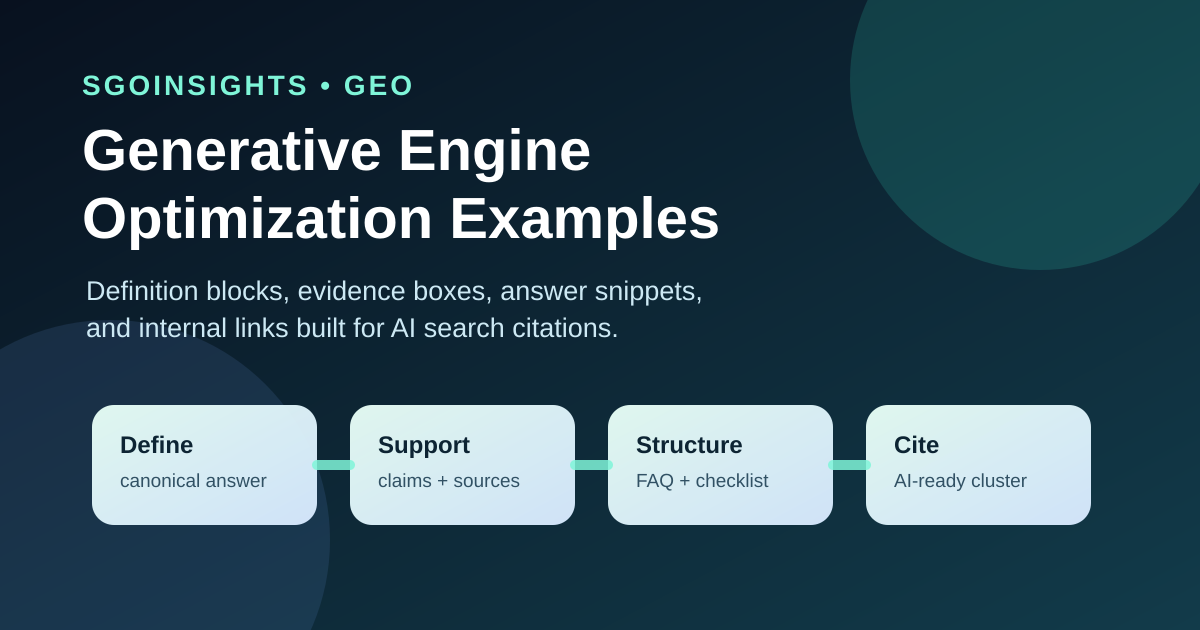
Generative Engine Optimization Research: Practical Takeaways
How to turn GEO research into clearer answer blocks, evidence, examples, and citation-ready page structure.
AI search framework
The core AI search disciplines
Three connected ways to make content visible, understandable, and citable across classic search, answer engines, and generative AI systems.
Search generative optimization guide
SGO
Search Generative Optimization is the operating framework for being visible in generated answers and traditional search.
Generative engine optimization guide
GEO
Generative Engine Optimization focuses on content structures and authority signals that make AI systems more likely to cite you.
Answer engine optimization guide
AEO
Answer Engine Optimization formats pages so direct-answer systems can extract a clean, defensible answer.
What does SGOinsights help you improve?
SGOinsights helps teams adapt search strategy to a market where discovery does not always end with a blue link. AI answer systems summarize pages, compare sources, extract definitions, and decide which brands or publishers are useful enough to mention. That creates a practical visibility problem: your content has to be findable by crawlers, understandable by machines, credible to readers, and structured clearly enough to be quoted or summarized.
The site focuses on the parts of AI search visibility that teams can actually control: clear entity definitions, direct answer formatting, strong internal links, schema, content depth, source credibility, and measurement. The goal is not to chase every new AI product, but to build pages that are easier for search engines, answer engines, and human readers to evaluate.
How should teams use SGO, GEO, and AEO together?
SGO, GEO, and AEO are not separate buzzwords that require separate content teams. They are layers of the same search visibility system. SEO keeps pages discoverable in traditional search. AEO makes answers easier to extract. GEO improves the chance that generative engines can retrieve, synthesize, and cite your content. SGO connects those practices into a broader strategy for AI-powered discovery journeys.
A practical workflow starts with one important topic, not with a tool. Define the entity, answer the core question directly, explain the surrounding context, add evidence or examples, link to supporting pages, and measure whether the page is being crawled, ranked, cited, or mentioned. The best AI search work usually looks like disciplined editorial work: clearer pages, better explanations, stronger internal architecture, and more useful resources.
What should you check before expecting AI citations?
Before expecting a page to appear in AI-generated answers, check the fundamentals. The page should be indexable, have one clear H1, use a title and meta description that match search intent, include a canonical URL, and provide enough context for a reader to understand the topic without jumping between sources. It should also use headings that map to real questions, not only marketing labels.
From there, strengthen the content with direct answers, examples, comparison points, structured data, and internal links to related guides. A page that is thin, vague, or isolated may still rank for branded queries, but it is less likely to be useful as a cited source in an answer engine. That is why SGOinsights treats AI search optimization as a combination of technical crawlability, editorial clarity, and source-level trust.
We also look for signals that make recommendations easier to verify: consistent terminology, named entities, useful source pages, and practical next steps that a reader can apply after the first visit.
Use the GEO Readiness Scanner to check whether a page has the basic structure needed for AI citation readiness.
Reader path and next step
SGOinsights pages are meant to be used, not skimmed once and forgotten. After reading this page, choose one next action: audit a live URL, compare a competing source, update a weak section, document an AI-answer test, or move to a related guide that gives the topic more depth.
This additional context is part of the site’s quality standard. Important pages should explain why they exist, who they help, what decision they support, and what a reader should do next. That makes the page more useful for humans and gives search systems a clearer reason to crawl, understand, and evaluate it.
- If the page is a guide, use it to make a concrete content or technical change.
- If the page is a policy, use it to understand how the site handles trust, privacy, editorial judgment, and monetization.
- If the page is a resource, use it with a real URL, prompt, query, or workflow instead of treating it as a static download.
- If the topic changes, revisit the page and refresh the examples, internal links, and recommendations.